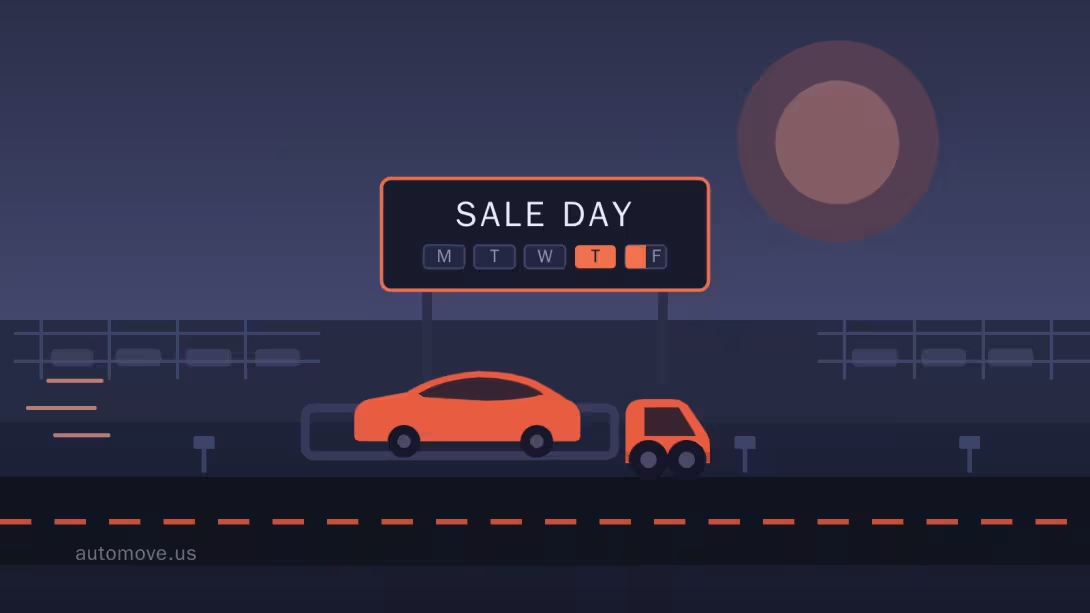
Buying at Manheim is the easy part. Getting the unit off the block and onto your lot is where the week actually gets decided — and the constraint is rarely the price of the truck. It's the gate.
We keep gate hours on file for all 80 Manheim locations we cover. When we parsed them, a pattern showed up that explains most of the transport delays dealers complain about: the Manheim week is not a nine-to-five week, and it ends far earlier on Friday than almost anyone plans for.
What makes Manheim transport different from salvage auction transport?
Three things, and they all work in a dealer's favour once the logistics are set up around them.
The units are operable. Wholesale vehicles roll, steer and brake, so they load on a standard open carrier in minutes with no winch and no extra deck space. That alone removes the $100–$300 non-runner premium that dominates salvage transport pricing.
The yards are built for trucks. All 80 Manheim locations on our site list a carrier-friendly loading area, and roughly six in ten also list on-site reconditioning and title processing. These are wholesale facilities that expect car haulers, not impound lots that tolerate them.
And the movement is repeatable. A salvage buyer ships one car from one yard once. A dealer buys from the same two or three auctions every month and runs the same lanes to the same lot — which is a completely different transport problem, and a much easier one to solve well.
When can a carrier actually collect from a Manheim yard?
This is the question that decides your timeline, so we measured it rather than guessing. Of the 80 Manheim locations we list, 79 publish structured gate hours. Here is what those 79 yards actually do.
First, most of them have a heavy day. At 52 of the 79, the gate opens earlier on exactly one weekday than on every other day of the week — typically an hour or two earlier. Six more yards have two such days, and 21 run flat hours all week. That early gate is the yard gearing up for its sale, and it tells you when the lot will be busiest:
| Day the gate opens earliest | Manheim yards |
|---|---|
| Thursday | 19 |
| Wednesday | 16 |
| Tuesday | 13 |
| Monday | 2 |
| Friday | 2 |
| Two or more early days | 6 |
| No early day (flat hours) | 21 |
So the wholesale week is a mid-week week: 48 of the 52 yards with a single early day open early on Tuesday, Wednesday or Thursday. Manheim Atlanta opens at 8:00AM Thursday against 9:00AM the rest of the week. Manheim Houston does the same on Tuesday. Manheim Phoenix opens at 7:00AM Thursday, two hours ahead of its Monday-to-Wednesday gate.
Why does the Friday cutoff cost you a weekend?
Because Friday at a Manheim yard is a half day, and the weekend is a closed door.
- Five of the 79 yards don't open on Friday at all.
- Of the 74 that do, 33 close by 12:00PM and 55 close by 1:00PM — roughly three in four.
- Not one of the 79 publishes weekend gate hours.
- The result is a median 68-hour window between Friday's gate closing and Monday's gate opening.
Now put that next to the sale-day table. There are 11 Manheim yards where the gate opens early on Thursday and closes by noon on Friday — Manheim Atlanta among them, at 8:00AM Thursday and shut at 12:00PM Friday. Buy on Thursday at one of those, and you have a single morning to get a truck through the gate. Miss it and the unit sits in the lot until Monday, not because anything went wrong, but because there is nobody there to release it.
That is the whole argument for booking transport before the sale rather than after it. The dispatch decision that saves you three days costs nothing on Wednesday and is impossible on Friday afternoon.
It is also worth knowing that this is a Manheim-specific rhythm. We ran the same parse across the 68 ADESA yards we cover: only 7 of them close by noon on Friday, against 33 at Manheim. If you buy at both, do not assume the same cutoff.
How long does the drive actually take?
Transit time is the other half of the timeline, and it is the half most quotes describe vaguely. Below are ten real dealer lanes running out of Manheim yards. The mileage is measured driving distance from that yard's own coordinates — not a straight line across a map — and the drive hours come from the same routing data.
| Lane | Road miles | Driving hours | Typical transit |
|---|---|---|---|
| Manheim Atlanta → Chicago | 693 mi | 13.6 hr | 2–3 days |
| Manheim Atlanta → Dallas | 787 mi | 14.3 hr | 2–3 days |
| Manheim Houston → Atlanta | 812 mi | 15.0 hr | 2–3 days |
| Manheim Chicago → Tampa | 1,125 mi | 21.5 hr | 3–4 days |
| Manheim New Jersey → Miami | 1,220 mi | 22.9 hr | 3–4 days |
| Manheim Fort Lauderdale → Chicago | 1,323 mi | 24.8 hr | 3–4 days |
| Manheim Houston → Los Angeles | 1,536 mi | 26.3 hr | 4–5 days |
| Manheim Phoenix → Chicago | 1,763 mi | 31.7 hr | 4–5 days |
| Manheim Chicago → Los Angeles | 2,013 mi | 35.3 hr | 5–6 days |
| Manheim Southern California → New York | 2,752 mi | 49.1 hr | 6–7 days |
Notice how far apart the driving hours and the transit days sit. A driver is capped at 11 hours behind the wheel in a duty period, and a loaded carrier is picking up and dropping other vehicles along the way, so a realistic figure is 400–500 loaded miles a day rather than a straight division of the clock. The transit column above applies that; treat it as an estimate, not a promise. What it is not is guesswork about the distance — that part is measured.
What does it cost to move a unit from Manheim to your lot?
Wholesale transport prices the same way every other car move prices: a per-mile rate applied to the real driving distance, falling as the haul gets longer. We broke that arithmetic down in detail, with the 2026 rate bands, in how much it costs to ship a car from an auction.
Operable dealer units sit at the friendly end of it. There's no non-runner premium, loading is fast, and Manheim yards are easy to service — all of which is why dealer lanes tend to price better than salvage lanes over the same distance.
Rather than print a number here that goes stale, we publish the current market range for these lanes every week in the Dealer Lane Report, and each lane page carries that week's range. If your lane is on the list above, the live figure is one click away.
What should you have ready before the truck arrives?
- The exact yard. Several markets have more than one Manheim facility, and they are not in the same place. Give the location name, not the metro.
- Your dealer number and the sale details — lane, run number and stock or VIN — so the yard can match the unit and confirm it is released.
- Gate release status. No yard hands over a vehicle before the sale is settled and the release is posted. This, not truck availability, is the usual reason a scheduled pickup slips.
- The delivery address and its hours. Your own receiving window matters as much as the auction's. A truck that arrives at 6:00PM on a lot that locks at 5:00PM has the same problem in reverse.
- Title status. Transport doesn't wait on the title, but your ability to retail the unit does — worth confirming while you're arranging the move rather than a week later.
Why dealer lanes get easier the second time
The first move on a lane is the expensive one in effort, not in dollars: working out which gate, which hours, who signs, where the truck stages. Run the same lane again and all of that is already known.
That is the real argument for treating wholesale transport as a standing arrangement rather than a series of one-off bookings. We cover pickups at Manheim locations nationwide, and the lanes we run most often are listed on our dealer transport page. Vehicles move under the carrier's cargo insurance, and you get the same yard-level detail on every one of our Manheim location pages — gate hours included, which is where this whole post came from.
Moving units between your own rooftops rather than out of an auction is a different calculation again — the trip is shorter, but the staff time is not. We measured ten of them in dealer trade transport.
Frequently asked questions
Can a transporter pick up from Manheim on a weekend?
No. None of the 79 Manheim locations we list with published gate hours posts weekend hours, and 33 of them close by noon on Friday. The practical effect is a median 68-hour gap between the Friday gate closing and the Monday gate opening, so a unit that misses Friday morning waits until Monday.
How soon after the sale can a carrier collect the vehicle?
As soon as the sale is settled and the yard posts the gate release — the vehicle is not available to any driver before that, regardless of when the truck is booked. Because most Manheim yards run their heavy day mid-week and close early Friday, booking transport before the sale rather than after it is what keeps a Thursday purchase from sitting over the weekend.
Do I need to be at the auction when the truck loads?
No. Manheim yards release to the carrier against the gate pass and the release paperwork, so the driver handles collection. What you do need is for the release to be posted and for the yard to have the correct carrier details — a driver who turns up unlisted gets turned away at the gate.
Is open or enclosed transport right for wholesale units?
Open transport for almost everything. Wholesale units are operable and headed for a retail lot, and an open carrier hauls eight to ten of them at a far lower cost per unit. Enclosed is worth the 30–60% premium on genuinely high-value inventory — exotics, low-mileage collectibles, anything already reconditioned to show condition.
Can several units from one sale ship together?
Yes, and it is the normal way dealers move wholesale inventory. Units bought at the same sale are already in the same yard with the same release timing, which is exactly the situation a carrier is built for — one gate visit, one set of paperwork, one trip. Tell us the count when you ask for a quote so the right equipment is assigned.
Buying at a Manheim sale this week? Get a free AutoMove quote in about two minutes. Tell us the yard and the delivery address and we'll price your exact lane — and work backwards from that yard's gate hours so the unit isn't the thing waiting.